Jensen Huang Was the Last Tycoon Standing on US-China Ties
Before a Chinese spy scandal engulfed him, Nvidia chief executive Jensen Huang was the only prominent American business leader still openly arguing for closer ties with Beijing in the second Trump era.
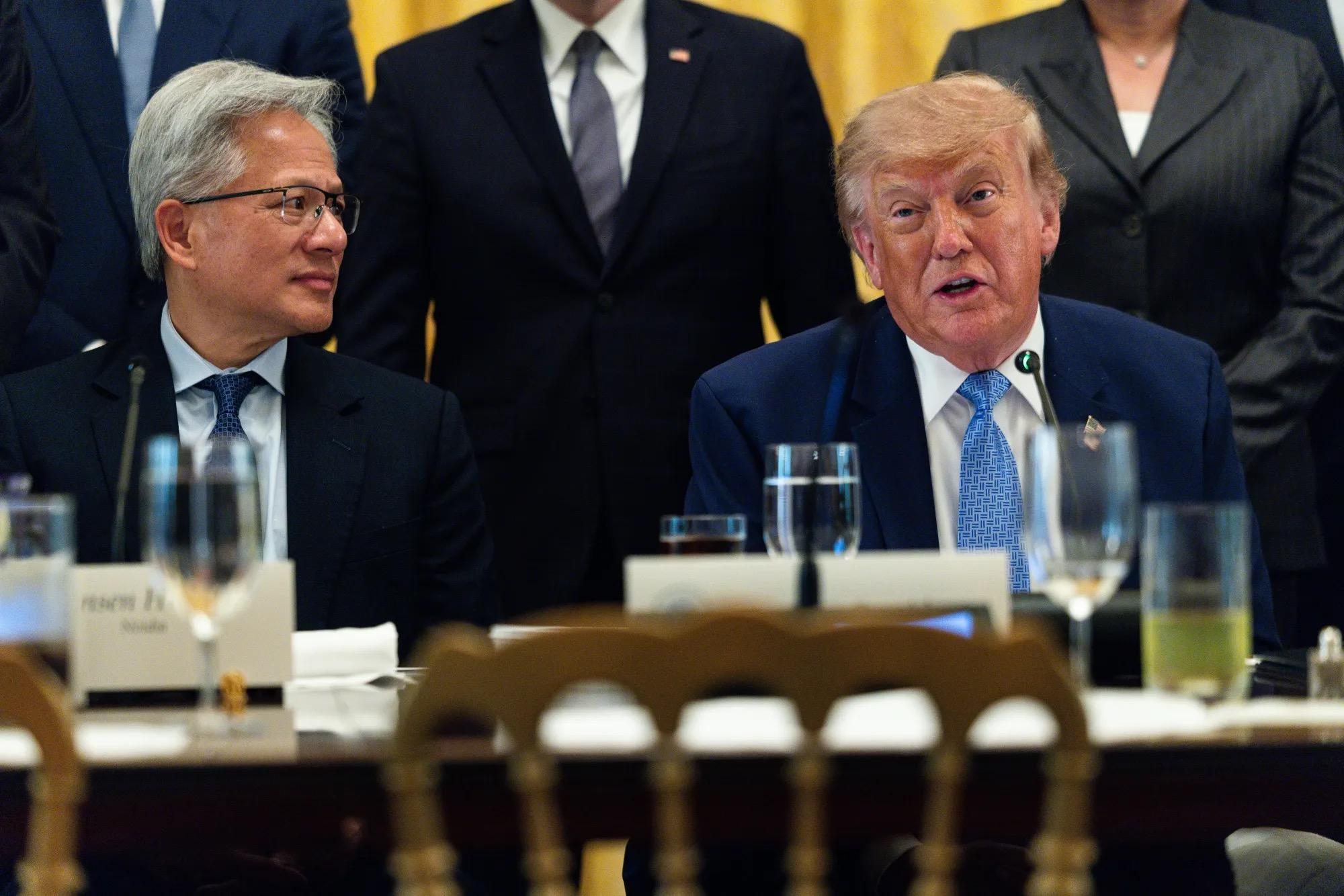
Jensen Huang and Donald Trump at the White House in September. · Source: Tierney L. Cross/The Washington Post
Before a Chinese spy scandal engulfed him, Nvidia chief executive Jensen Huang was the only prominent American business leader still openly arguing for closer engagement with Beijing in the second Trump era. His diminished credibility now risks complicating things not just for the chipmaker, but for any American company hoping to do business with China.
Huang's position was already unusual. Most high-profile American corporate titans have spent the Trump 2.0 years keeping their distance from China, or at least keeping quiet about it. Tim Cook stepped down as Apple's chief executive in August. Elon Musk has watched Tesla's sales stall in China while his attention is pulled across his sprawling tech empire and his role as a Republican financier.
A different era
The contrast with earlier years is striking. Mark Zuckerberg of Meta once famously jogged through Tiananmen Square. Sundar Pichai of Alphabet played Go for the cameras on a Beijing visit. American technology executives treated China as both a market and a stage, happy to be seen courting officials and consumers alike.
Those days are gone. A decade of tariff pressure has taught visiting chief executives to maintain a low profile, shift operations and strategy toward other markets, and avoid drawing Donald Trump's displeasure. Public warmth toward Beijing is now seen as a political liability in Washington.
Why Huang mattered
Huang stood out because he kept making the case that the United States and China needed a functional commercial relationship. Nvidia's dominance in artificial intelligence chips gave him a platform no other executive could match. When he spoke about export controls and market access, policymakers and investors listened.
That influence made him a bridge between two economies that are otherwise drifting apart. It also made him a target. The revelation of an alleged affair with a woman US intelligence suspects of working for China has now thrown his judgment into question and handed critics an easy argument that American tech leaders are too close to Beijing.
The new silence
The episode is likely to deepen the caution already visible among American executives. If the most vocal advocate for engagement can be knocked down by a personal and national security scandal, the incentive for others to speak up disappears. Silence becomes the safest strategy.
For companies with significant China exposure, the risk is that the political climate in Washington becomes even harder to navigate. Lawmakers who were already sceptical of Chinese market access will point to Huang as evidence that tighter restrictions are needed. Executives who might have lobbied for a more measured approach may decide the fight is not worth the reputational cost.
What comes next
Huang's fate at Nvidia is now tied to an independent board investigation. Even if he survives professionally, his authority as a spokesman for US-China business cooperation has been weakened. The void he leaves is unlikely to be filled quickly.
The broader lesson is that personal conduct and geopolitics are now tightly intertwined for leaders of strategic American companies. In a climate where any link to China is scrutinised, the last tycoon standing on US-China ties may have been the last one willing to stand there at all.